
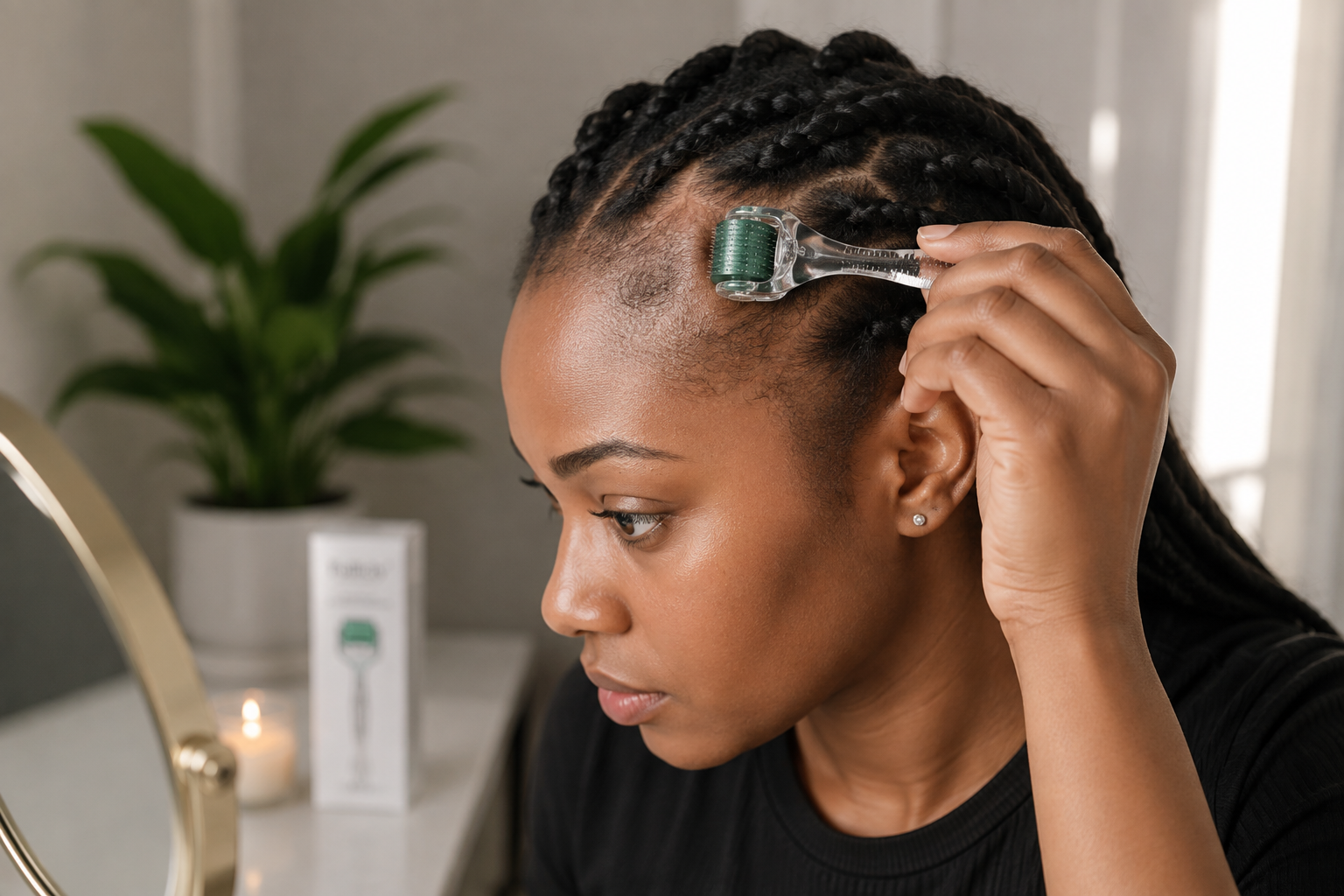
Traction alopecia is one of the most preventable forms of hair loss — yet it's also one of the most common, particularly among people who regularly wear tight hairstyles like braids, weaves, ponytails, or extensions. The good news is that when caught early enough, traction alopecia is reversible. Microneedling is emerging as a useful tool in that recovery process.
Here's what you need to know about using microneedling for traction alopecia — including when it can help, when it can't, and how to use it safely.
What Is Traction Alopecia?
Traction alopecia is hair loss caused by repeated, prolonged tension on the hair follicles. Over time, this mechanical stress damages the follicle and disrupts the normal hair growth cycle. It most commonly affects:
- The hairline (particularly the temples and edges)
- The nape of the neck
- Any area under consistent tension from styling
In early stages, the follicles are stressed but still alive. In advanced stages, chronic tension causes permanent scarring of the follicle — at which point regrowth is no longer possible.
Can Microneedling Help with Traction Alopecia?
The answer depends critically on the stage of hair loss:
Early-Stage Traction Alopecia (✅ Microneedling Can Help)
If the follicles are stressed and miniaturised but not yet scarred, microneedling can support recovery by:
- Increasing blood flow to the affected area, delivering oxygen and nutrients to stressed follicles
- Stimulating growth factors (including Wnt pathway proteins) that encourage follicle reactivation
- Enhancing absorption of topical treatments like minoxidil applied to the hairline
- Promoting collagen remodelling in the scalp tissue around the follicle

Advanced Traction Alopecia with Scarring (❌ Microneedling Cannot Help)
If the follicles have been permanently scarred (a condition called scarring alopecia or cicatricial alopecia), microneedling cannot regenerate destroyed follicles. In these cases, hair transplant surgery is the only option for restoring hair to the affected area.
How to tell the difference: A dermatologist can assess whether follicles are still present using dermoscopy or a scalp biopsy. If you're unsure about your stage, get a professional assessment before starting treatment.
The Most Important Step: Remove the Cause
No treatment — microneedling, minoxidil, or anything else — will work if the traction continues. Before starting any recovery protocol, you must:
- ❌ Stop or significantly reduce tight hairstyles
- ❌ Avoid extensions, weaves, or braids that pull on the affected area
- ❌ Switch to looser, protective styles that don't stress the hairline
- ✅ Give the scalp a rest period of at least 4–8 weeks before assessing recovery
Microneedling accelerates recovery — but only once the cause has been removed.
How to Use Microneedling for Traction Alopecia

Step 1: Choose the right tool
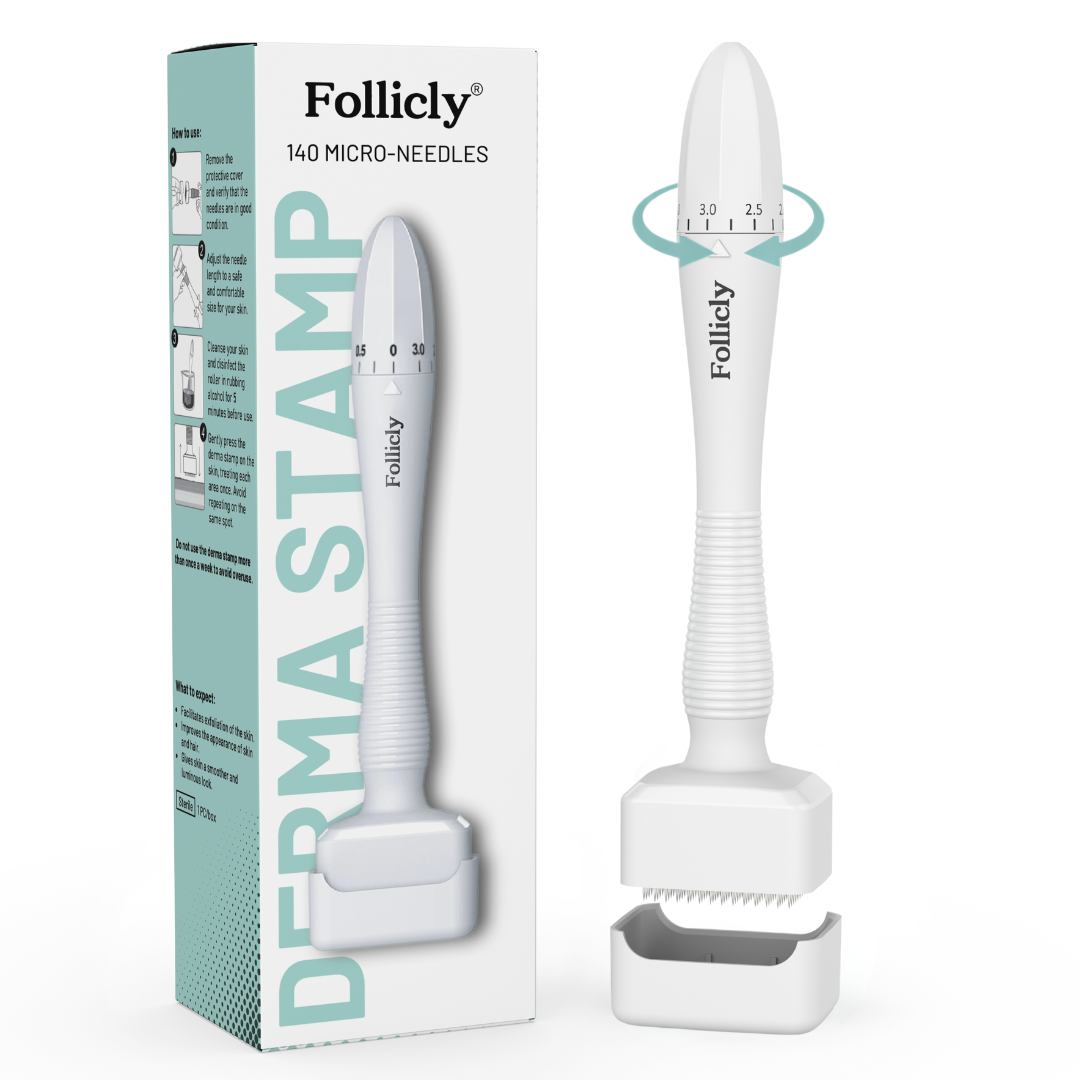
For traction alopecia, which typically affects the hairline and edges, the Follicly Derma Stamp is the ideal tool. Its precise stamping action allows you to treat the narrow hairline zone without affecting surrounding skin. The Follicly Derma Pen is also effective and offers adjustable depth for different zones.
Step 2: Start with a conservative needle depth
Begin with 0.5mm. The hairline and temple skin is thinner and more sensitive than the top of the scalp. Once you've assessed your skin's response after 2–3 sessions, you can consider moving to 0.75mm if needed.
Step 3: Treat 1–2 times per week
At 0.5mm, treating the affected hairline area 1–2 times per week is appropriate. Allow at least 48–72 hours between sessions to let the area recover.
Step 4: Apply minoxidil immediately after
Topical minoxidil applied to the hairline immediately after microneedling is one of the most effective combinations for traction alopecia recovery. The micro-channels created by needling increase minoxidil absorption significantly. See our guide: How to Microneedle with Minoxidil for Best Hair Results.
Step 5: Follow aftercare carefully
The hairline is a visible area — redness and sensitivity will be noticeable. Follow the full aftercare protocol: no heat styling, no tight hairstyles, no sun exposure for 24 hours post-session. See our scalp microneedling aftercare guide.
What Results to Expect
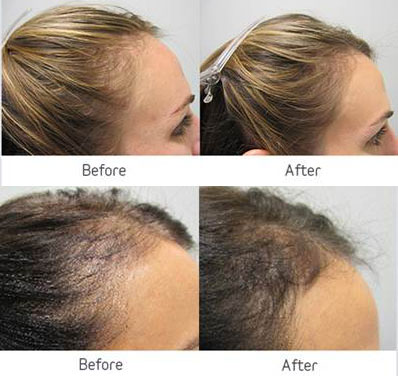
For early-stage traction alopecia with consistent treatment:
- Weeks 4–8: Fine vellus hairs may begin appearing along the hairline
- Months 3–4: Vellus hairs thickening into terminal hairs, improved hairline density
- Months 5–6: Meaningful recovery of the hairline in responsive cases
Results depend heavily on how early treatment begins and how completely the traction source is removed. For the full results timeline, see: Derma Roller Results Timeline: What to Expect at 1, 3, and 6 Months.
Traction Alopecia vs. Androgenetic Alopecia: Key Differences for Treatment
| Factor | Traction Alopecia | Androgenetic Alopecia |
|---|---|---|
| Cause | Mechanical tension | DHT / genetics |
| Location | Hairline, edges, nape | Crown, top of scalp, hairline |
| Reversibility | Yes (if caught early) | Partial (with treatment) |
| First step | Remove the cause | DHT blocking (finasteride/saw palmetto) |
| Microneedling role | Supportive (reactivation) | Primary (stimulation + absorption) |
| Finasteride needed? | No | Often yes (men) |
The Bottom Line
Microneedling is a genuinely useful tool for early-stage traction alopecia — but only after the source of tension has been removed. Used consistently with minoxidil and proper aftercare, it can meaningfully accelerate hairline recovery. If you're unsure whether your traction alopecia is early or advanced, see a dermatologist for an assessment before starting treatment.