
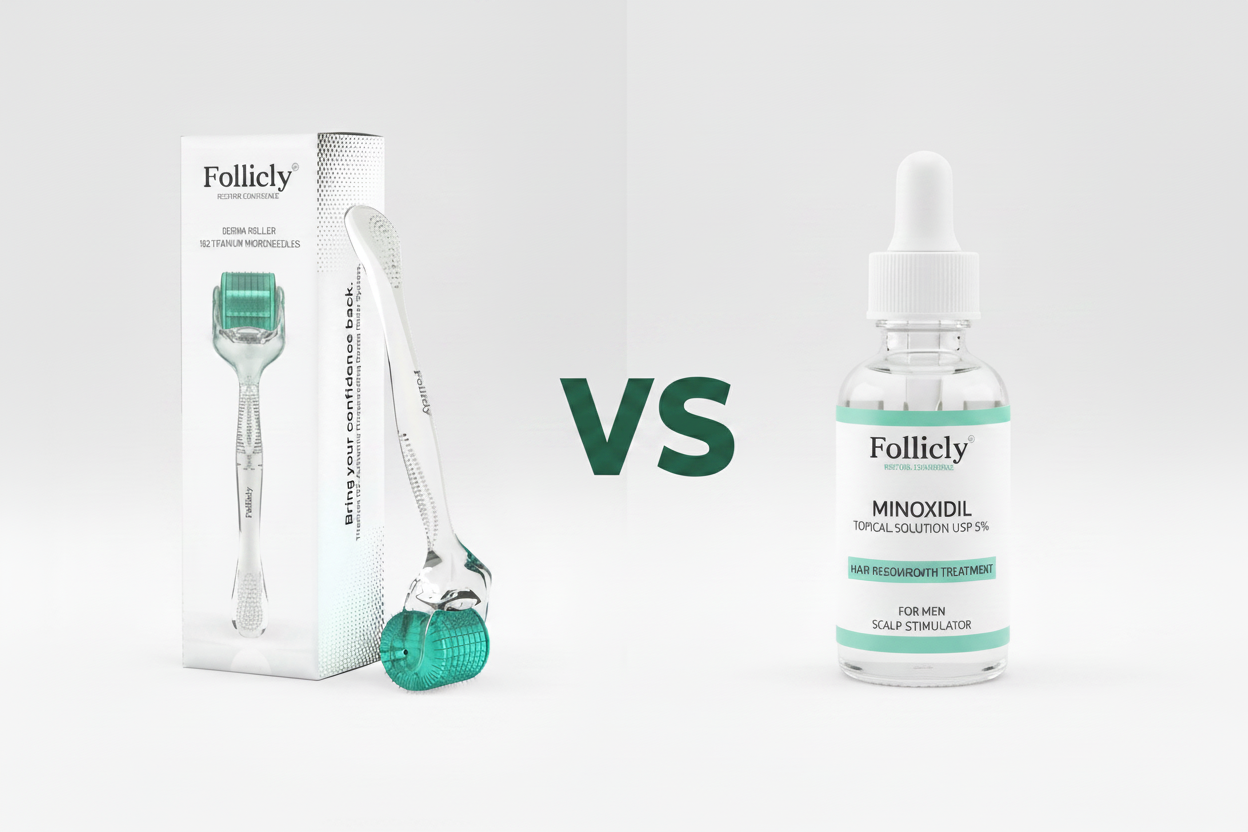
If you're researching hair loss treatments, you've almost certainly come across both microneedling and minoxidil. Both have solid evidence behind them, both are accessible at home, and both can produce meaningful results. But which one is actually more effective — and do you need to choose?
How Each Treatment Works

Minoxidil
Minoxidil is an FDA-approved topical (and oral) treatment for androgenetic alopecia. It works by:
- Widening blood vessels in the scalp, increasing blood flow and nutrient delivery to follicles
- Prolonging the anagen (active growth) phase of the hair cycle
- Shortening the telogen (resting) phase, pushing follicles back into active growth sooner
It does not address DHT — the hormone driving androgenetic alopecia — so it treats the symptom (follicle miniaturisation) rather than the cause.
Microneedling
Microneedling works through a different mechanism entirely:
- Creates controlled micro-injuries that trigger a wound-healing responseStimulates collagen production and increases blood flow to the scalp
- Upregulates growth factors (Wnt3a, Wnt10b, β-catenin) that activate dormant follicles
- Dramatically increases the absorption of topical treatments applied immediately after
What the Research Shows

The landmark comparison study (Dhurat et al., 2013) directly pitted microneedling + minoxidil against minoxidil alone in men with androgenetic alopecia over 12 weeks. The results were striking:
- Microneedling + minoxidil group: Average of 91.4 new hairs per cm²
- Minoxidil alone group: Average of 22.2 new hairs per cm²
That's more than 4x the hair count improvement with the combination. Importantly, this study used minoxidil at the same dose in both groups — the only variable was the addition of microneedling.
Other studies comparing microneedling alone to minoxidil alone have shown broadly comparable results, with some favouring microneedling and others favouring minoxidil depending on the protocol used.
Head-to-Head Comparison
| Factor | Microneedling | Minoxidil |
|---|---|---|
| Mechanism | Growth factor stimulation, collagen, absorption boost | Blood flow, prolongs growth phase |
| FDA approval | No (device, not drug) | Yes (topical and oral) |
| Evidence level | Strong (multiple RCTs) | Very strong (decades of data) |
| Addresses DHT? | No | No |
| Side effects | Temporary redness, sensitivity | Initial shedding, possible irritation, facial hair (5%) |
| Frequency | 1–3x per week | Once or twice daily |
| Time to results | 3–6 months | 3–6 months |
| At-home use | Yes | Yes |
| Works best when | Combined with minoxidil | Combined with microneedling |
So Which Is Better?
The honest answer: neither is clearly superior when used alone. The evidence suggests they're broadly comparable as standalone treatments. But the more important finding from the research is that the combination is dramatically more effective than either one alone.
Microneedling and minoxidil work through complementary mechanisms — they don't compete, they compound. Microneedling creates the channels; minoxidil floods through them. The result is significantly greater hair count improvement than either treatment can achieve independently.
When to Choose One Over the Other

Choose microneedling as your primary tool if:
- You want to avoid daily topical application
- You've had side effects from minoxidil (irritation, facial hair growth)
- You prefer a non-pharmaceutical approach
- You're already using minoxidil and want to significantly boost its effectiveness
Choose minoxidil as your primary tool if:
- You want the most extensively studied, FDA-approved option
- You're not ready to commit to a microneedling routine yet
- You want a simple daily application with no session prep
Use both if:
- You're serious about maximising results — this is the evidence-backed optimal approach
- You want to get the most out of your minoxidil without increasing the dose
The Optimal Protocol: Both Together

The most effective at-home hair loss protocol combines microneedling sessions with immediate post-needling minoxidil application. For the complete weekly schedule, see our complete hair loss routine guide.
For step-by-step instructions on combining both treatments, see: How to Microneedle with Minoxidil for Best Hair Results.
Getting Started

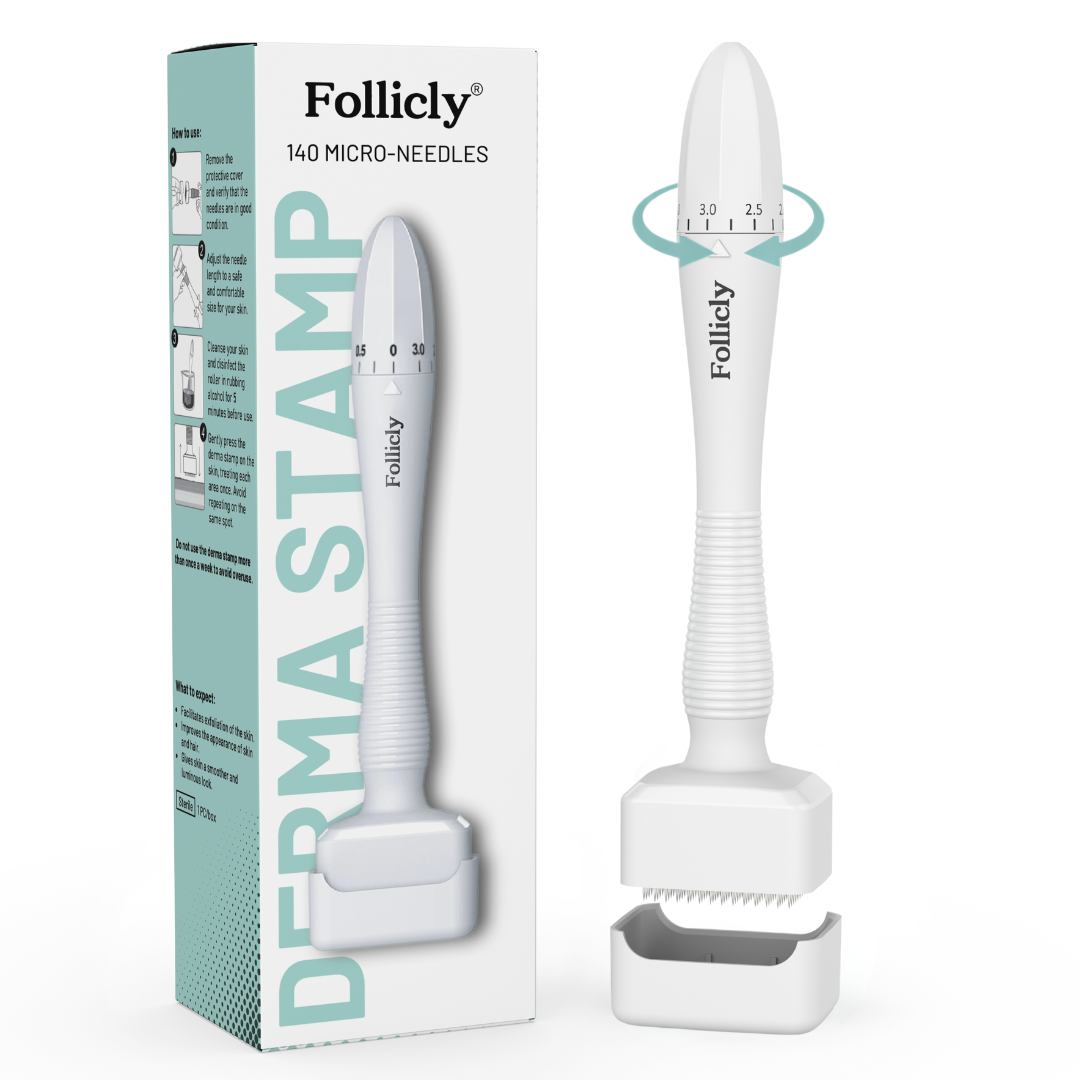
If you're ready to add microneedling to your routine, the Follicly Derma Stamp is the ideal starting point for targeted treatment, while the Follicly Derma Pen offers adjustable depth for full-scalp coverage. Both are designed to work seamlessly alongside your existing minoxidil routine.
Note: This article is for informational purposes only. Consult a healthcare professional before starting any new hair loss treatment.