


Microneedling has emerged as one of the most promising complementary treatments for androgenetic alopecia (pattern hair loss). In recent years, clinical research has shown that controlled microneedling of the scalp can stimulate hair follicles and significantly improve the effectiveness of treatments such as minoxidil.
However, one important question remains:
What needle size actually works best for hair regrowth?
While many online sources suggest that deeper needles produce better results, scientific studies indicate that moderate needle depths may actually be more effective.
In this article we’ll review the scientific evidence on microneedling depth and explain which needle sizes appear to produce the best results.
How Microneedling Stimulates Hair Growth

Microneedling works by creating small controlled micro-injuries in the scalp using fine needles.
These micro-injuries trigger the body’s wound-healing response, which stimulates hair follicles through several biological mechanisms.
Growth factor release
Microneedling stimulates the release of growth factors involved in hair regeneration, including platelet-derived growth factor and vascular endothelial growth factor.
Activation of follicle stem cells
Research suggests that microneedling can activate stem cells located in the hair follicle bulge region, which helps initiate the growth phase (anagen) of the hair cycle.
Improved absorption of topical treatments
Microneedling creates microscopic channels in the scalp that allow topical treatments such as minoxidil to penetrate more effectively.
Because of these mechanisms, microneedling is increasingly used alongside standard hair loss treatments.
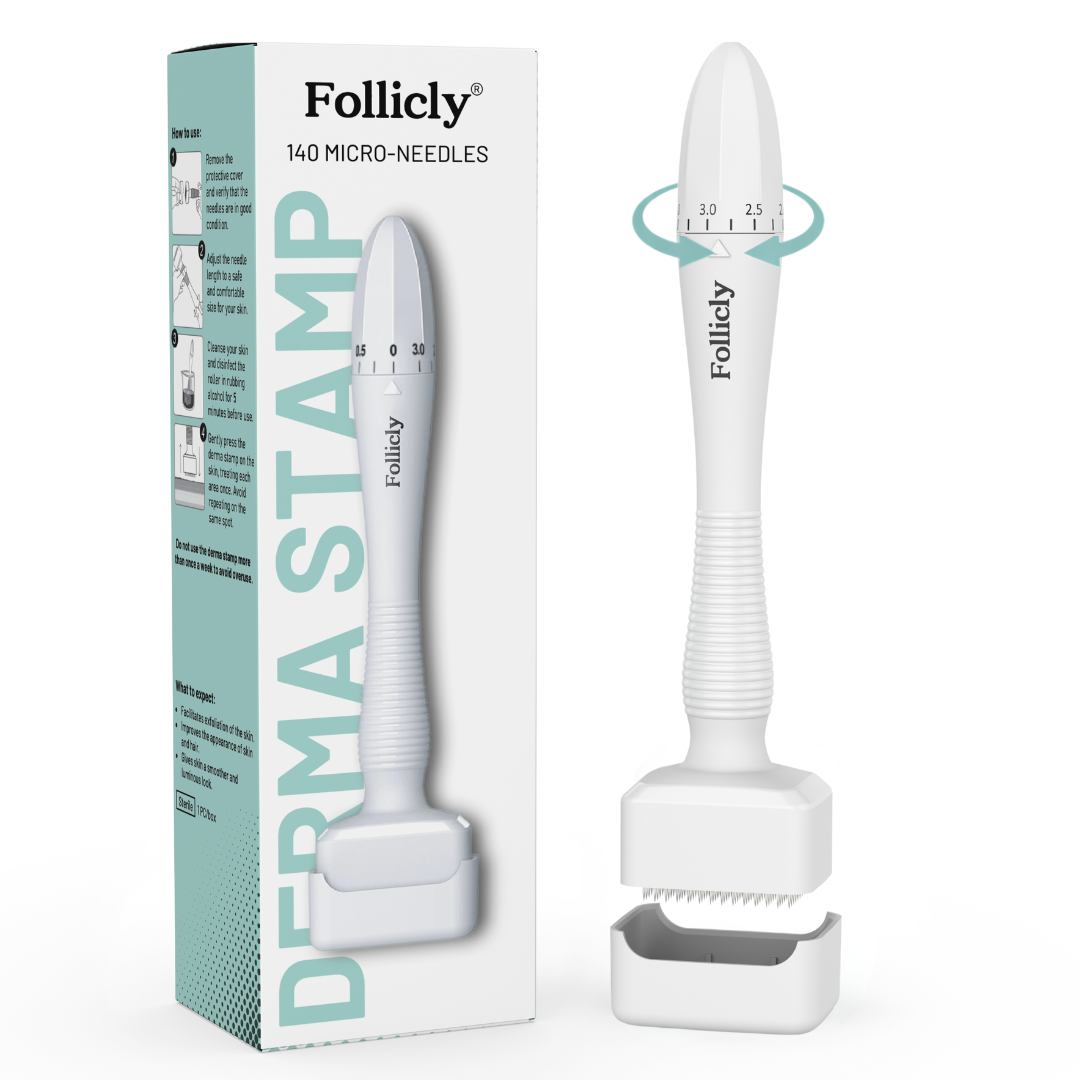
➡️ Tools designed specifically for scalp microneedling, such as the Follicly Derma Stamp, allow precise needle depth control for consistent stimulation.
Evidence From Clinical Research
The Landmark 2013 Microneedling Study
One of the first randomized controlled trials investigating microneedling for hair loss was conducted by Dhurat et al. (2013).
In this study, patients with androgenetic alopecia were divided into two groups:
1) Minoxidil only
2) Minoxidil combined with weekly microneedling
After 12 weeks, the microneedling group experienced significantly greater hair regrowth compared with the minoxidil-only group.
The authors concluded that microneedling can be a powerful adjunct therapy for hair loss treatment.
This study helped establish microneedling as a legitimate approach for stimulating hair growth.
➡️ Many people now incorporate microneedling tools like the Follicly Derma Stamp into their hair-regrowth routine alongside topical treatments.
What Needle Depth Works Best?

Most microneedling devices used for hair loss operate within the following range:
0.5 mm to 1.5 mm
However, researchers have recently started investigating whether smaller needle depths may actually work better.
The 0.6 mm vs 1.2 mm Clinical Study
A clinical study published in the Journal of Cosmetic Dermatology compared two microneedling depths in patients with androgenetic alopecia.
Researchers divided 60 patients into three groups:
1. Minoxidil only
2. Minoxidil + microneedling at 0.6 mm
3. Minoxidil + microneedling at 1.2 mm
After 12 weeks, both microneedling groups experienced significantly greater hair growth than the minoxidil-only group.
However, an interesting finding emerged:
The group treated with 0.6 mm needles showed better hair growth outcomes than the 1.2 mm group.
Researchers suggested that moderate needle depths may stimulate the follicle environment effectively without causing excessive trauma to the scalp.
Why this matters
Many people assume deeper needles produce stronger results.
But this study suggests that moderate stimulation may actually be optimal for hair follicles.
➡️ The Follicly Derma Stamp can be adjusted precisely to 0.6 mm — allowing users to match the needle depth used in this clinical study.
Evidence From Systematic Reviews
More recent systematic reviews and meta-analyses confirm that microneedling improves hair regrowth when combined with standard treatments.
These reviews consistently show that:
1) Microneedling significantly increases hair count and hair density
2) Combining microneedling with minoxidil produces better results than medication alone
3) Moderate needle depths appear to be effective for stimulating hair follicles
Importantly, researchers emphasize that consistency of treatment may be more important than extremely deep needle penetration.
➡️ Devices with adjustable depth settings — such as the Follicly Derma Stamp — allow users to maintain consistent treatments across sessions.
Recommended Needle Sizes Based on Current Evidence
Based on the available research, the following needle depths are most commonly recommended.
| Needle Depth | Purpose |
|---|---|
| 0.5–0.6 mm | Strong stimulation with minimal scalp trauma |
| 1.0 mm | Deeper stimulation for thicker scalp areas |
| 1.5 mm | Occasionally used in clinical settings |
The available evidence suggests that around 0.6 mm may be an optimal depth for many users.
➡️ Because the Follicly Derma Stamp features adjustable needle depth, it can easily be set to 0.6 mm for treatments aligned with current research.
Why Many Users Prefer Derma Stamps Over Rollers

While dermarollers were the first popular microneedling devices, many practitioners now prefer derma stamps for scalp treatments.
Derma stamps offer several advantages:
1. More precise needle depth
2. Less hair tangling during treatment
3. Vertical penetration instead of rolling pressure
4. Better control in areas like the temples and hairline
Because derma stamps apply needles vertically, they allow more controlled and consistent stimulation of the scalp.
➡️ The Follicly Derma Stamp was specifically designed for scalp microneedling and hair-regrowth treatments.
Conclusion
Clinical research increasingly supports microneedling as a useful complementary treatment for hair loss.
Studies show that:
- Microneedling significantly improves the effectiveness of topical treatments like minoxidil
- Moderate needle depths may be more effective than very deep needles
- A clinical study found 0.6 mm performed better than 1.2 mm for stimulating hair regrowth
Consistency and proper technique appear to be the most important factors for achieving results.
➡️ The Follicly Derma Stamp allows precise depth adjustment — including 0.6 mm — making it easy to follow microneedling protocols supported by current research.
Start Your Microneedling Routine
Microneedling is one of the most promising non-surgical methods for stimulating hair growth.
When performed consistently and combined with proven treatments like minoxidil, it can significantly improve hair regrowth outcomes.
If you're looking for a microneedling tool designed specifically for scalp treatments:
👉 Try the Follicly Derma Stamp
Adjustable needle depth. Precision microneedling. Designed for hair growth.